

Today's Verse
For you formed my inward parts;
you knitted me together in my mother's womb.
I praise you, for I am fearfully and wonderfully made.
Wonderful are your works;
my soul knows it very well.
— Psalm 139:13-14 (ESV)
Historical Context
Psalm 139 is a psalm of David, likely written during his reign, though the setting is personal rather than political. Unlike many of his psalms, it does not cry out from a battlefield or a cave. It is a meditation — David alone before God, thinking hard about what it means to be fully known.
The psalm has four movements: God knows me (vv. 1-6), God is everywhere I go (vv. 7-12), God made me (vv. 13-18), and God, judge my enemies and search my heart (vv. 19-24). Our passage sits at the hinge. Having confessed that he cannot escape God's presence, David turns to the reason: God is the one who made him in the first place.
The language is deliberately vivid. "Knitted" is the word used for weaving tapestry. "Intricately woven in the depths of the earth" borrows imagery from the hidden formation of the world itself in Genesis — David is saying that the womb is as mysterious and God-crafted as the foundations of creation. Ancient readers did not have ultrasounds; they saw the womb as a sealed, secret place. David's point is that nothing is hidden from God, not even that.
And then verse 16 makes a staggering claim: God wrote the days of David's life in a book before any of them existed. This is not fatalism. It is the confession that a personal God, not blind chance, stands behind every human life. The psalm was sung in Israel's worship as an act of surrender to the God who authored both the singer and the song.
Reflection
We live in an age that tells you your body is raw material — something to be edited, optimized, or discarded when inconvenient. Psalm 139 cuts against every part of that. Your body is not a project. It is a work of God.
David does not say he became precious once he accomplished something. He says he was fearfully and wonderfully made in the womb, before he had done anything. Before he killed Goliath, before he was anointed king, before he sinned with Bathsheba and repented in ashes — before any of it, God was already at work forming him and writing his days.
This has weight for how you see yourself and how you see others. The child in the womb is not potential life; he is life, known by name in the mind of God. The elderly woman losing her memory is not a burden to be managed; she is a soul whose days were written before time. The person you find hard to love was knit together by the same hands that made you. There is no such thing as a disposable human being.
It has weight for how you see your own days too. You did not stumble into existence. The days you are living — including this Monday, with its ordinary tasks and hidden struggles — were written in God's book before the world began. He is not surprised by any of it. He is not scrambling to redeem what has gone off script.
And when you awake, verse 18 says, you are still with Him. The God who formed you has not stepped away. In Christ, He has come nearer still — bearing your sin, rising in your flesh, and promising that the book He wrote about you ends in glory.
For Reflection
What changes about today if you truly believe that this day was written in God's book before you were born?
Prayer
Father, we praise You, for we are fearfully and wonderfully made. You knit us together when no one else could see. You wrote our days before we drew breath. Forgive us for despising the bodies You gave us, for treating human life as cheap, for living as though our days were our own. Teach us to receive this day from Your hand, and to see every person we meet as Your handiwork. Keep us with You when we wake and when we sleep. In Jesus' name, Amen.
Recent Devotionals
The Ladder Came Down to a Fugitive — July 19, 2026
Nowhere You Can Go That He Is Not — July 16, 2026
When No One Cares for Your Soul — July 14, 2026
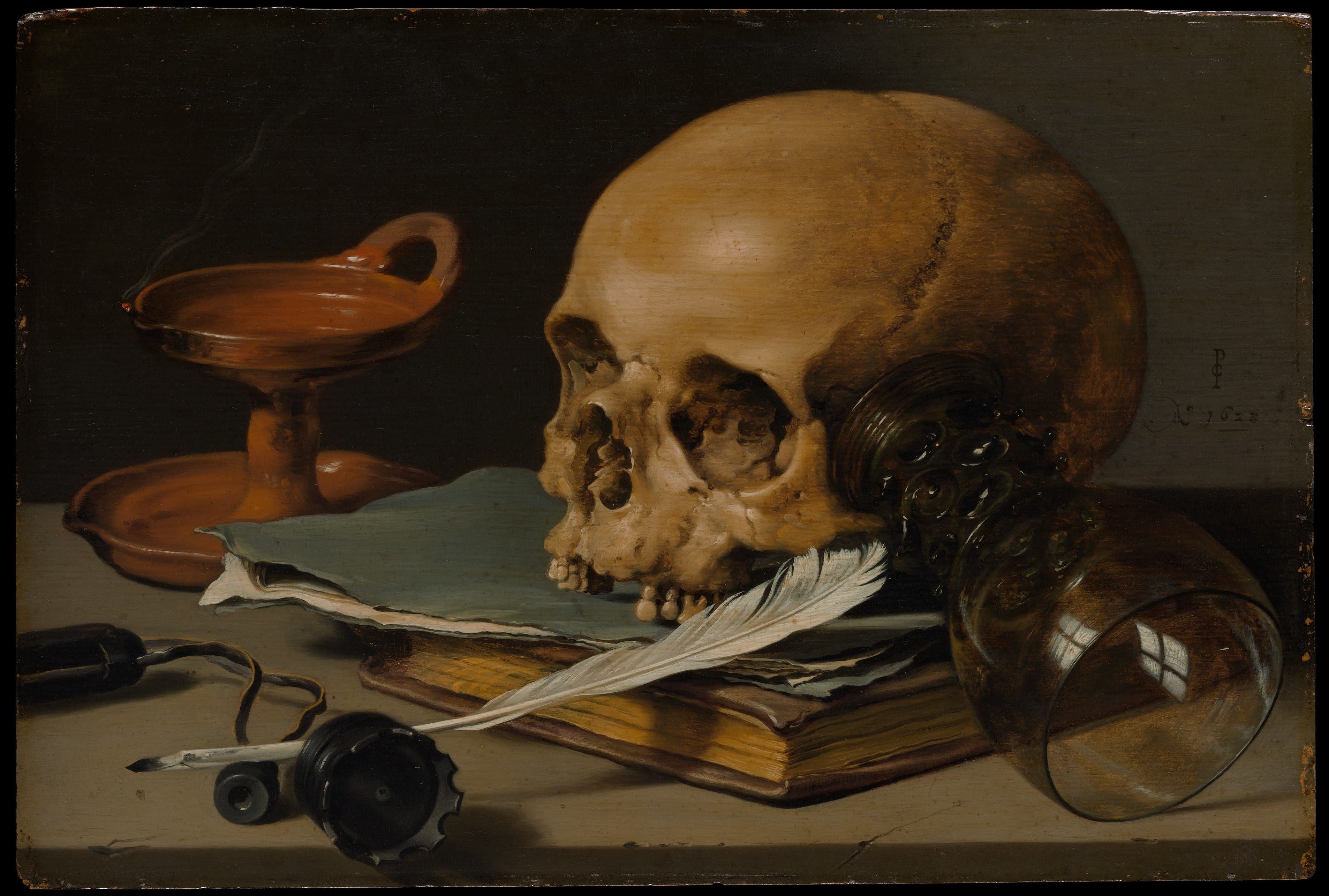
Image: Pieter Claesz, Still Life with a Skull and a Writing Quill, c. 1628, Metropolitan Museum of Art, New York — Rogers Fund, 1949 via The Metropolitan Museum of Art.
Scripture quotations are from the ESV® Bible (The Holy Bible, English Standard Version®), copyright © 2001 by Crossway, a publishing ministry of Good News Publishers. Used by permission. All rights reserved.
"....promising that the book He wrote about you ends in glory."
🩵
Beautiful work, and Psalm 139 is one of my favorites❣️🙏😻