

Today's Verse
[4] “Behold, I am of small account; what shall I answer you?
I lay my hand on my mouth.
[5] I have spoken once, and I will not answer;
twice, but I will proceed no further.”
Job 40:4-5 (ESV)
Historical Context
The book of Job belongs to the wisdom literature of the Old Testament. Its setting is ancient — Job lives like a patriarch, before Moses and the Law — though the book itself was likely written down and refined later for Israel's instruction. The story is simple and devastating: a righteous man loses his children, his wealth, and his health, and then endures cycles of debate with friends who insist his suffering must be punishment for hidden sin. Job protests his innocence and, as the chapters wear on, begins to demand a hearing with God. He wants to argue his case. Beginning in chapter 38, God finally answers — but not with explanations. Instead, He takes Job on a tour of creation: the foundations of the earth, the sea, the stars, the wild donkey, the ostrich, the warhorse. By the time we reach chapter 39, God is asking about the hawk and the eagle. He is not lecturing Job on biology. He is showing Job who is God and who is not.
Reflection
Most of us, sooner or later, end up where Job ended up. We have a case to make against heaven. The diagnosis came back wrong. The marriage ended. The child wandered. The prayer went unanswered for years. We rehearse our arguments in the dark, and we want a courtroom.
God's answer to Job is striking because it is not really an answer to Job's question. Job asked, in effect, Why? God replied, Look at the hawk. He pointed to a bird Job had never taught to fly, to an eagle nesting on a cliff Job had never climbed, to creatures whose habits Job did not order or sustain. The argument is not that Job is too small to matter. The argument is that Job is too small to judge.
And notice what this does to Job. It does not crush him — it frees him. "I lay my hand on my mouth." That is not despair. That is worship. The moment a sufferer realizes that the One on the throne is genuinely God — wise beyond tracing out, sovereign over every cliff and every wing — the demand for explanation begins to dissolve into trust.
This is the same God who, in the fullness of time, did not stay aloof from our suffering but entered it in His Son. The God who governs the hawk also hung on a cross. He has not owed us an explanation, yet He has given us Himself. The cross does not answer every why, but it silences the suspicion that God is indifferent. He is not.
So when life puts you on Job's ash heap, do not be afraid to lay your hand on your mouth. Worship is often the end of the argument and the beginning of peace.
For Reflection
What is the question you have been arguing with God about — and what would it look like to lay your hand on your mouth and trust Him with it this week?
Prayer
Almighty God, You alone command the hawk and the eagle, and You alone hold my life. Forgive me for the times I have argued as though I knew better than You. Teach me the holy silence of Job — not the silence of despair, but the silence of trust. When I cannot understand Your ways, give me eyes to see Your Son on the cross, and a heart that rests in Your wisdom. In Jesus' name, Amen.
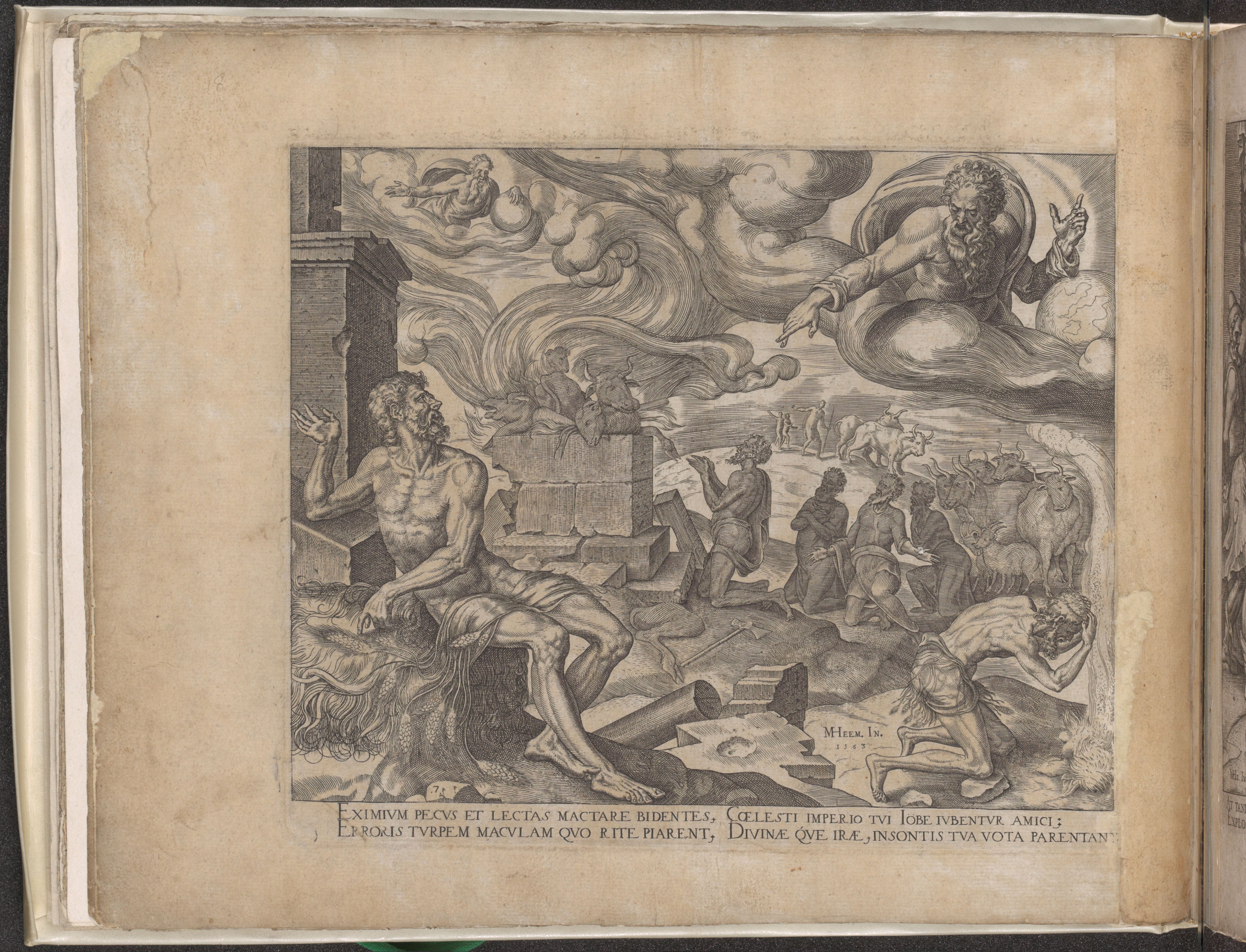
Image: Rijksmuseum, File:God spreekt tot Job, RP-P-1988-297-18.jpg, c. 1563 — CC0 via Wikimedia Commons.
Scripture quotations are from the ESV® Bible (The Holy Bible, English Standard Version®), copyright © 2001 by Crossway, a publishing ministry of Good News Publishers. Used by permission. All rights reserved.
I've long thought that if God was capable of sarcasm, he does it in response to Job's very fair question. God tells Job something like this: "Where were you when I created the universe? He calls Job a "critic." He is a good man suffering terribly. He wants life to make sense. Israel means to "wrestle" with God. The Hebrews felt they had the right to use their brains, and when life makes no sense, they have the right to question. After the Holocaust Eli Wiesel said, do we not have the right to ask, why? The hardest question for Christian apologists to answer is why God causes or allows suffering. From Job to Wiesel much has been written but the question stubbornly remains.
Job was the most wise person knowing God's love for him in his heart who understood the GOD's mighty presence even in times of the trials and the wickedness which gripd him and he felt helpless but chose to trust God even in midst of the harsh arguments. Job is the book where GOD's fullness is felt as a Judge and job advocating his own case. Job was filled with God's love for him and he understood God's mighty power.
We all need the same wisdom which allow us resting in God and trusting Him in every situation.
Amen.