

Today's Verse
But we see him who for a little while was made lower than the angels, namely Jesus, crowned with glory and honor because of the suffering of death, so that by the grace of God he might taste death for everyone.
Hebrews 2:9
Historical Context
Hebrews was written to Jewish Christians, likely before the Temple's destruction in A.D. 70, who were tempted to drift back into the safer waters of synagogue Judaism. Confessing Jesus as Messiah had cost them homes, livelihoods, and standing. The author, whose identity the early church never settled on, writes a long sermon arguing that Christ is greater than every glory of the old covenant — greater than angels, Moses, Aaron, the sacrifices, the Temple itself.
In chapter 1 he has just established that the Son is higher than the angels. So why, in chapter 2, does he quote Psalm 8 about man being made lower than the angels? Because his readers needed to understand the strange shape of Christ's victory. Psalm 8 is a meditation on Genesis 1 — humanity crowned to rule creation under God. But anyone with eyes can see we do not rule creation. We are ruled by death, by sickness, by sin, by Caesar. The promise looks broken.
The original readers knew this acutely. Their friends had been imprisoned (Heb. 10:34). Some had been killed. The world was not in subjection to them; they were being crushed by it. The author does not deny this. He says plainly: "At present, we do not yet see everything in subjection to him." Then he pivots. We do not yet see the kingdom in full — but we see Jesus. One Man has already walked through death and come out crowned. The dominion Adam lost, the Last Adam has won, and He has won it precisely through suffering.
Reflection
There is an honesty in this passage that we need. The writer does not pretend the world looks redeemed. He does not tell suffering Christians to squint harder until everything appears fine. He concedes the obvious: we do not yet see all things subject to Christ. Cancer still kills. Tyrants still reign. Our own sins still surprise us with their stubbornness. The crown promised to humanity in Psalm 8 is not on our heads.
But then comes the pivot that holds the Christian life together: "But we see Jesus." Not yet the consummation. Not yet every tear wiped away. Not yet the lion lying down with the lamb. But we see the Man — true God and true man — who has already gone ahead of us through the worst the world could do, and who now wears the crown on our behalf. His glory is not a consolation prize for our defeat. It is the firstfruits of our victory. Where He has gone, His people will follow.
Notice how He was crowned: "because of the suffering of death." Not around it. Not in spite of it. Because of it. He tasted death for everyone — not as a tragic accident but as the very means of His exaltation and our salvation. The cross is not a detour from glory; it is the road to it, for Him and for us.
So when your faith feels thin because the world looks unredeemed — look where Hebrews tells you to look. Not at the chaos. At Jesus. Crowned. Alive. Reigning. Holding your name.
For Reflection
Where in your life are you tempted to lose hope because you do not yet see Christ's victory — and what would change if you looked at Him instead of at the chaos?
Prayer
Father, we confess that our eyes grow tired. We look at the world, at our families, at our own hearts, and we do not see all things subject to Your Son. Lift our gaze. Let us see Jesus — wounded, risen, crowned, reigning. Teach us to trust that the road of suffering He walked is the road that leads to glory, and that He walks it with us still. Hold us until faith becomes sight. In Jesus' name, Amen.
Recent Devotionals
All Night on the Mountain Before Choosing Twelve — June 17, 2026
Streams in the Desert of Our Waiting — June 16, 2026
Sowing in Tears, Reaping in Joy — June 15, 2026
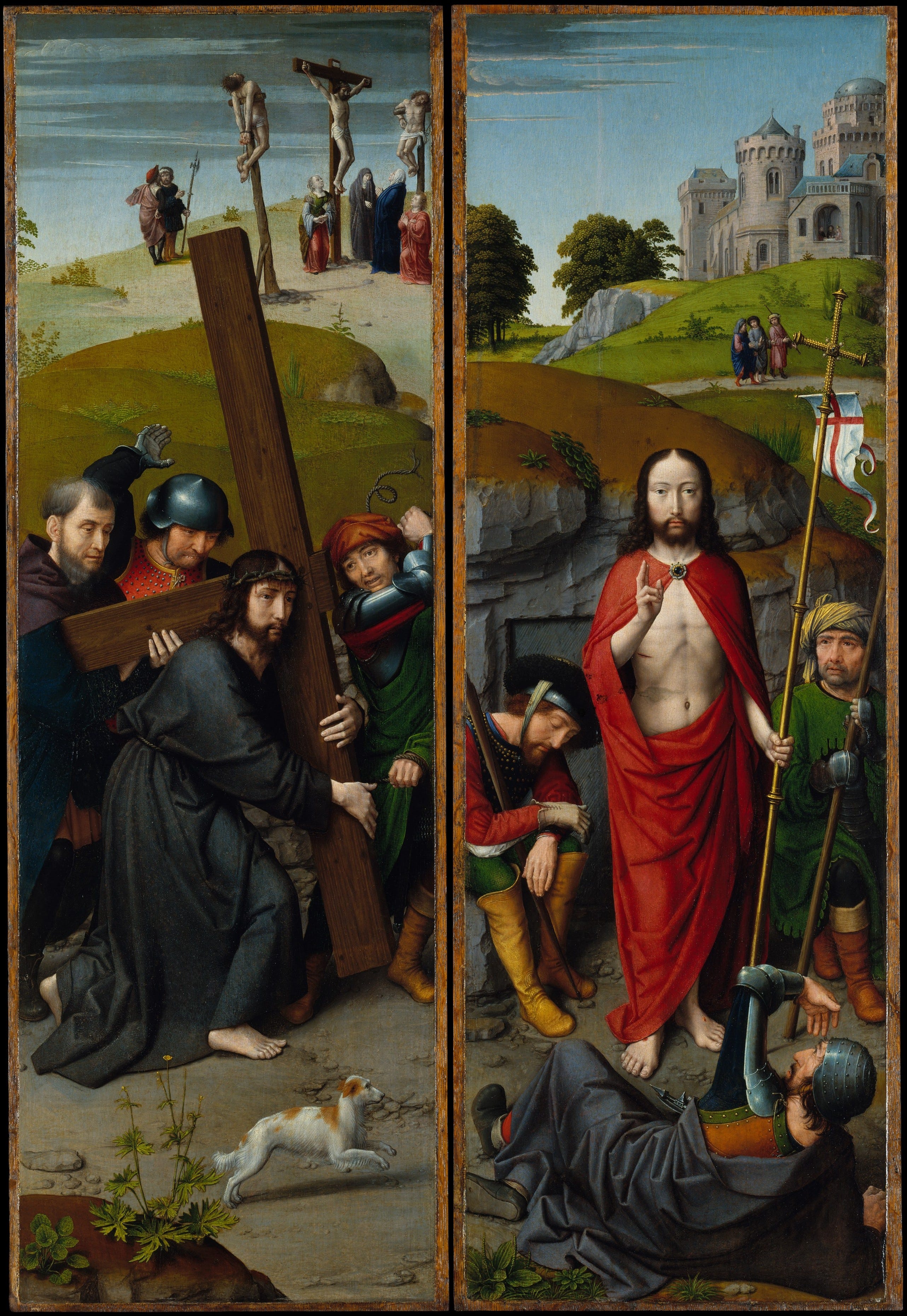
Image: Gerard David, Christ Carrying the Cross, with the Crucifixion; The Resurrection, with the Pilgrims of Emmaus, c. ca. 1510, Metropolitan Museum of Art, New York — Robert Lehman Collection, 1975 via The Metropolitan Museum of Art.
Scripture quotations are from the ESV® Bible (The Holy Bible, English Standard Version®), copyright © 2001 by Crossway, a publishing ministry of Good News Publishers. Used by permission. All rights reserved.
AMEN Brother❣️ This world is full of Troubles and Suffering But We Will Not Give Up For our Hope is built on nothing less than Jesus and His Righteousness❣️Fight the good fight for The Battle Is The Lords‼️💯🤩🙏😻