

Today's Verse
But with you there is forgiveness, that you may be feared.
Psalm 130:4
Historical Context
Psalm 130 is one of fifteen Songs of Ascents (Psalms 120-134), a small collection pilgrims sang as they climbed the road up to Jerusalem for the great feasts. Jerusalem sits on a ridge, so every approach was literally an ascent, and the songs move with that climb: from distress toward the temple, from exile toward home, from the depths toward the presence of God.
We do not know the author. The psalm is anonymous and undated, but its language of iniquity, redemption, and waiting fits the piety of Israel after the exile, when the community had learned, hard, that their deepest problem was not political but moral. They had been carried off to Babylon not because God failed them but because they had broken covenant. Return to the land had not fixed the human heart.
The cry from the depths would have been familiar imagery. In Hebrew poetry, deep waters stand for chaos, drowning, the grave, the pit of Sheol. To cry from the depths is to cry as one already going under.
The reference to watchmen is concrete. Watchmen stood on the city walls through the long night shifts, straining for the first grey light that meant their duty was ending and the city was safe. Anyone who had stood a watch, or waited with a sick child, or hidden through a night of danger, knew that particular ache: the longing that dawn would just come.
That is the posture the pilgrim brings up to the temple. Not confidence in his own record, but hope in a God who forgives.
Reflection
Notice what the psalmist does not do. He does not minimize his sin, and he does not despair of it. He cries from the depths, but he cries to the Lord. Both halves matter.
Many of us do one or the other. Some of us are experts at the depths. We know our failures intimately, replay them at 3 a.m., and let the weight press us into a quiet hopelessness. Others of us have learned to keep the depths at arm's length. We stay busy, stay respectable, stay just distracted enough that we never have to look honestly at what we are. Psalm 130 will not let us do either. It insists we tell the truth about our sin and then tells the truth about our God.
Verse 4 is the hinge, and it is startling: "But with you there is forgiveness, that you may be feared." We might have expected the opposite, that God's severity produces fear and his mercy produces casual affection. Scripture says the reverse. It is the God who forgives who is truly feared, because only he holds our souls in his hand. A god who merely condemned could be avoided. A God who pardons at the cost of his own Son must be worshipped.
And that is where this psalm points. The plentiful redemption of verse 7 was not fully seen until a Friday outside Jerusalem, when the Lord himself went down into depths no watchman could measure and rose on the third day like the morning the psalmist longed for. If you are waiting in the dark today, wait there. The dawn has a name, and he has already come.
For Reflection
Where in your life are you currently waiting for God, and are you waiting like a watchman for the morning, or like someone who has stopped expecting the sun?
Prayer
Lord, out of the depths we cry to you. We do not pretend our sins are small, and we do not pretend we can lift ourselves out. But with you there is forgiveness, purchased by the blood of your Son and offered freely to all who repent. Teach us to wait for you as watchmen wait for the morning, trusting your word, resting in your steadfast love, and fearing you rightly because you have shown us mercy. In Jesus' name, Amen.
Recent Devotionals
God Sent Me Before You to Preserve Life — August 16, 2026
The Long Memory of an Unconfessed Sin — August 15, 2026
Stoned at Lystra, Preaching at Derbe — August 14, 2026
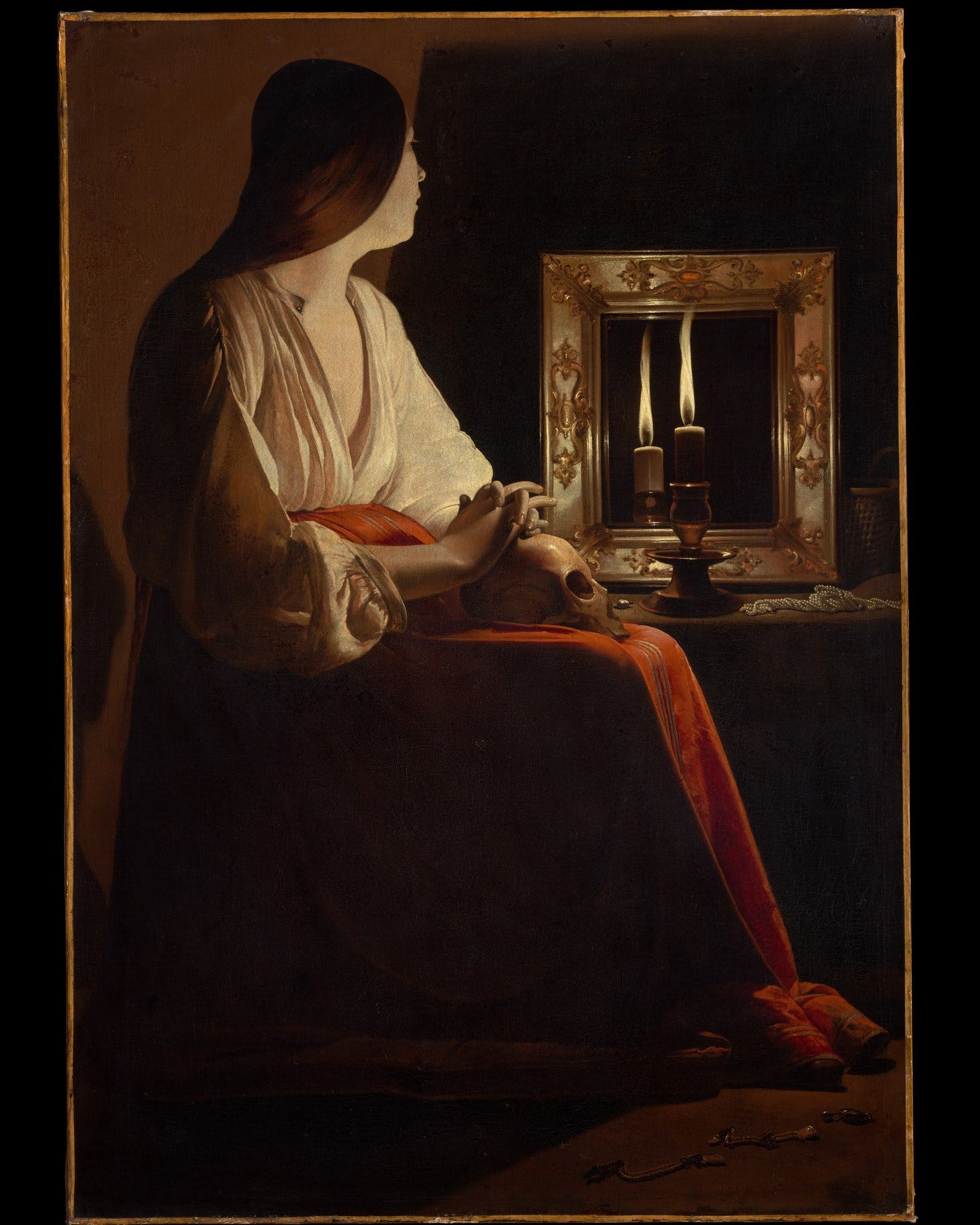
Image: Georges de La Tour, The Penitent Magdalen, c. ca. 1640, Metropolitan Museum of Art, New York — Gift of Mr. and Mrs. Charles Wrightsman, 1978 via The Metropolitan Museum of Art.
Scripture quotations are from the ESV® Bible (The Holy Bible, English Standard Version®), copyright © 2001 by Crossway, a publishing ministry of Good News Publishers. Used by permission. All rights reserved.
That was a great lesson, now I have to reread Ps. 120 to 134. Thank you
AMEN and HALLELUJAH‼️🙏 He has paid for ALL our sins-past present and future, Great Is Your Faithfulness, AMEN 🙏❤️✝️❤️🩹🎉🙏😻