

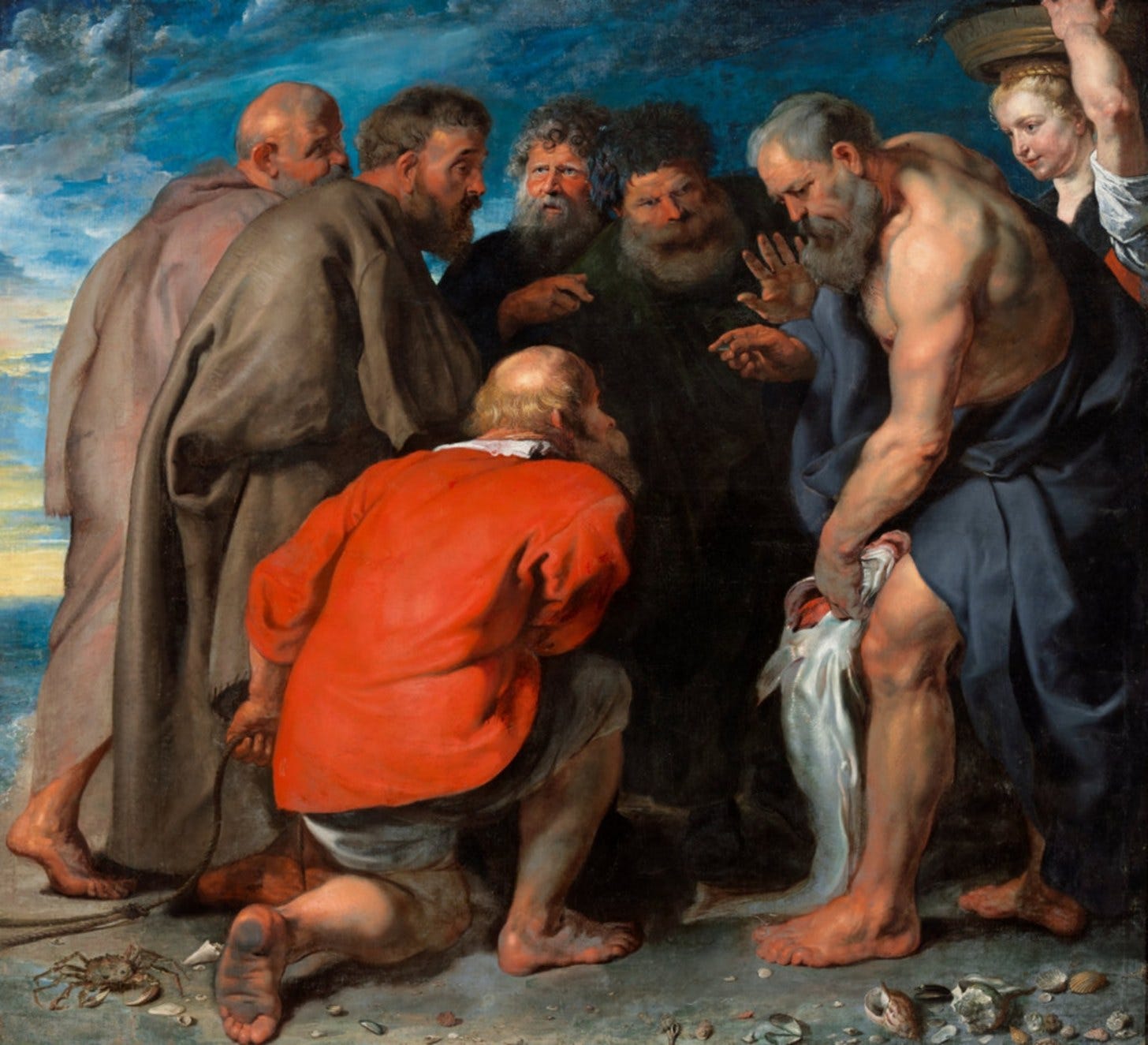
Today's Verse
Then the sons are free. However, not to give offense to them, go to the sea and cast a hook and take the first fish that comes up, and when you open its mouth you will find a shekel. Take that and give it to them for me and for yourself.
Matthew 17:26-27
Historical Context
Matthew writes to readers steeped in the Old Testament in the decades after the Resurrection, showing from every angle that Jesus is the promised Messiah and the divine Son. By chapter 17 we are in the second half of his Gospel, where Jesus has set his face toward the cross. The Transfiguration has just happened on the mountain. Now, back in Galilee, he tells the Twelve a second time that he will be handed over, killed, and raised.
The two-drachma tax is not a Roman tax. It is the temple tax commanded in Exodus 30:13-16, half a shekel from every Israelite male over twenty, used to maintain the sanctuary and its sacrifices. By the first century it was collected annually, usually before Passover. Capernaum was Peter's hometown and had become Jesus' base of operations, so the collectors would know exactly where to find him.
Their question to Peter has an edge. Some teachers, particularly priests, argued they were exempt. By asking whether Jesus pays, the collectors are probing whether this traveling rabbi considers himself above the obligation. Peter answers yes, probably without thinking it through.
The shekel Jesus tells Peter to retrieve from the fish is a stater, worth exactly four drachmas, enough to cover the tax for two men. The command assumes a reader who knows the coinage, the exemption customs for royal households, and the weight of the temple itself. The passage sits between the second passion prediction and the disciples' argument about greatness in chapter 18. Matthew is quietly asking: who is this man, and what sort of king is he?
Reflection
Notice what Jesus does not do. He does not refuse the tax, and he does not pay it as though he owed it. He pays it under protest of a sort, and his protest is a claim about his identity.
Kings do not tax their own sons. The temple is his Father's house. The sacrifices offered there point to him. The whole system the tax funds exists for his sake. He is not a tenant in the house of God, obligated like everyone else. He is the Son. Peter, who has just confessed him as the Christ a chapter earlier, is being taught again, slowly, who it is he follows.
And yet the Son pays. Not because he owes, but so as not to give offense. The one who could rightly stand on his privileges lays them down. That is the pattern of the whole Gospel. He was not obliged to be born of a woman. He was not obliged to be baptized by John. He was not obliged to be numbered with transgressors on a cross. He owed none of it. He did all of it. The temple tax episode is the cross in miniature, a free Son choosing to be bound.
This has bite for us. We like to insist on what is owed to us, on our freedoms, our rights, our exemptions. The Son who owned the temple fished a coin out of a lake rather than cause a stumbling block. If he yielded for the sake of others, our clinging to every entitlement starts to look very small. Christian freedom is not freedom to assert ourselves. It is freedom to serve.
For Reflection
Where in your life are you standing on what you are owed, when the Son who owned everything chose to yield for the sake of others?
Prayer
Lord Jesus, Son of the living God, you owned the temple and yet paid its tax. You owed nothing and yet gave everything. Teach me the freedom that lays itself down. Loosen my grip on what I think is mine. Let me never insist on my rights at the cost of another soul's stumbling. Make me, like you, free to serve, free to yield, free to love. In your name, Amen.
Paid subscribers get the study section below: the word behind the English, the setting, and where this thread runs through the rest of Scripture.