

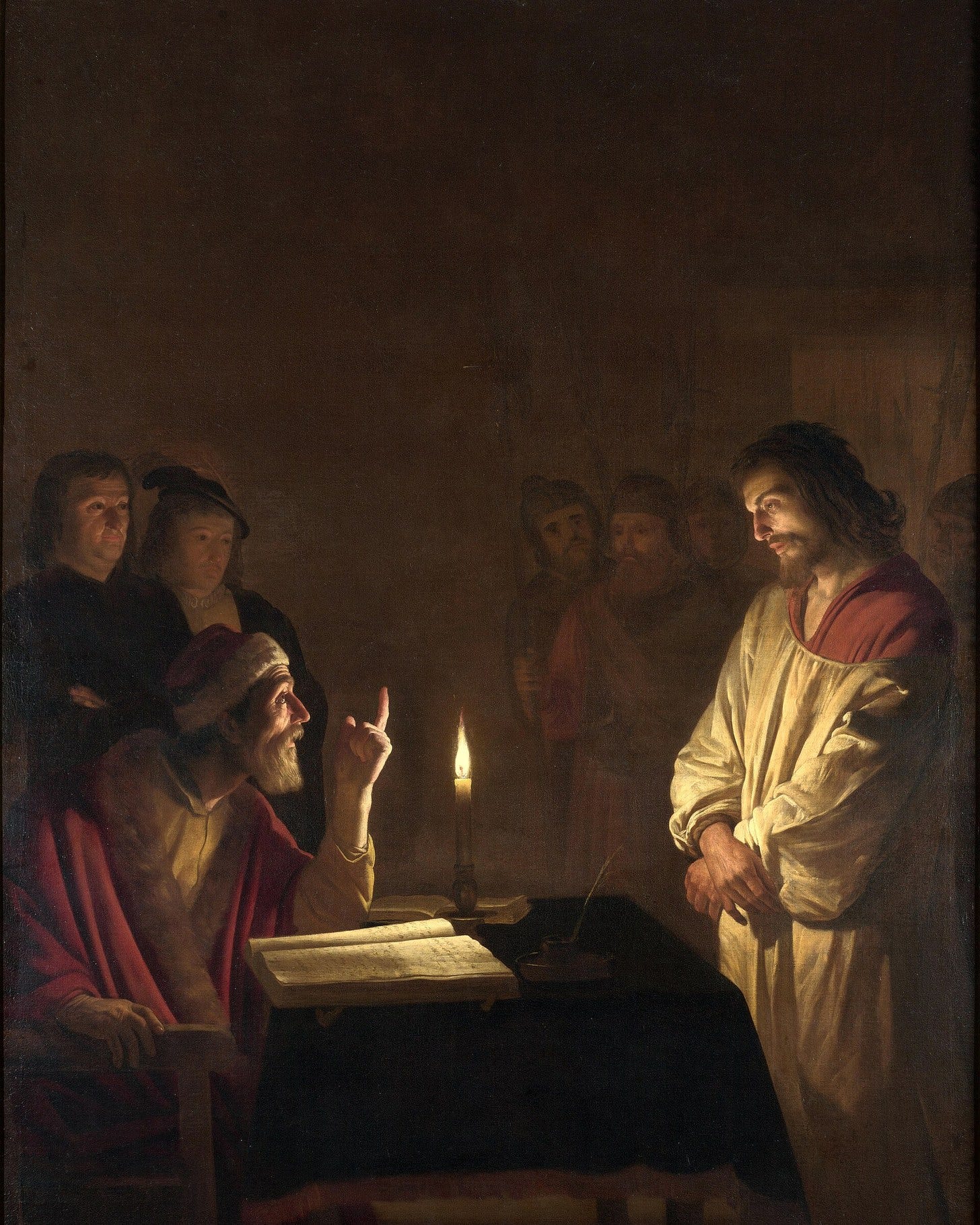
Today's Verse
He did not say this of his own accord, but being high priest that year he prophesied that Jesus would die for the nation, and not for the nation only, but also to gather into one the children of God who are scattered abroad.
John 11:51-52
Historical Context
John writes his Gospel late in the first century, likely from Ephesus, for a mixed audience of Jewish and Gentile believers. By chapter 11 his narrative has reached a hinge. Jesus has just raised Lazarus at Bethany, roughly two miles from Jerusalem, in full view of mourners who had come out from the city. The sign was undeniable, and word travelled fast.
The council John names is the Sanhedrin, the ruling body of seventy-one elders, chief priests and scribes, led by the high priest. Judea in the AD 30s was under direct Roman rule through a prefect, and the Sanhedrin held religious authority and limited civil power at Rome's pleasure. Their fear in verse 48 is not paranoid. A messianic movement that drew crowds was exactly the kind of thing Rome crushed with legions, and the chief priests knew their position depended on Roman tolerance. Their 'place' almost certainly means the temple.
Caiaphas held the high priesthood from roughly AD 18 to 36, an unusually long tenure that signals how skilled he was at managing Rome. John's phrase 'high priest that year' does not mean the office rotated annually, but marks out that fateful year of the crucifixion. Readers would have known that on the Day of Atonement the high priest alone entered the Holy of Holies with sacrificial blood for the sins of the people. When Caiaphas speaks of one man dying for the nation, he speaks as the very office whose entire purpose was substitution. He means political calculation. John hears something else entirely, and tells us so plainly.
Reflection
Caiaphas thought he was being shrewd. One troublesome Galilean dead, the Romans pacified, the temple safe, his own seat secure. He weighed a life against a nation and found the math obvious. What he did not know, what John wants us to see, is that God was speaking through him. The high priest, in the year of the true sacrifice, declared the gospel in a sentence he meant as politics: it is better that one man should die for the people.
This is how sovereign God is. The man plotting the murder of the Son of God cannot open his mouth without preaching substitutionary atonement. The enemies of Christ become unwilling witnesses to Christ. The cross they are planning as a cover-up is the very altar on which the Lamb of God will take away the sin of the world.
And notice what John adds in verse 52. Jesus does not die only for the nation, but to gather into one the children of God who are scattered abroad. The death Caiaphas intended to protect a shrinking circle actually breaks the circle open. Jew and Gentile, near and far, you and I: gathered by the blood of one man dying in our place.
There is a quiet comfort here for anyone who feels the world is spinning out of God's hands. The powers that killed Jesus were not improvising on a God caught off guard. They were, without knowing it, serving the plan laid before the foundation of the world. The schemes of men do not thwart the purposes of God. They fulfil them. And at the centre of that fulfilment is a cross that was meant for you.
For Reflection
Where in your life right now do you need to trust that God is working his purposes through circumstances that look like defeat?
Prayer
Father, we thank you that even the schemes of your enemies could not derail your plan to save us. You turned a political murder into the sacrifice that reconciles the world. Teach us to trust your hand when we cannot trace it. Gather us, with all your scattered children, into the one flock of your Son. We rest in the finished work of Christ, who died in our place and rose again. In Jesus' name, Amen.
Paid subscribers get the study section below: the word behind the English, the setting, and where this thread runs through the rest of Scripture.