

Today's Verse
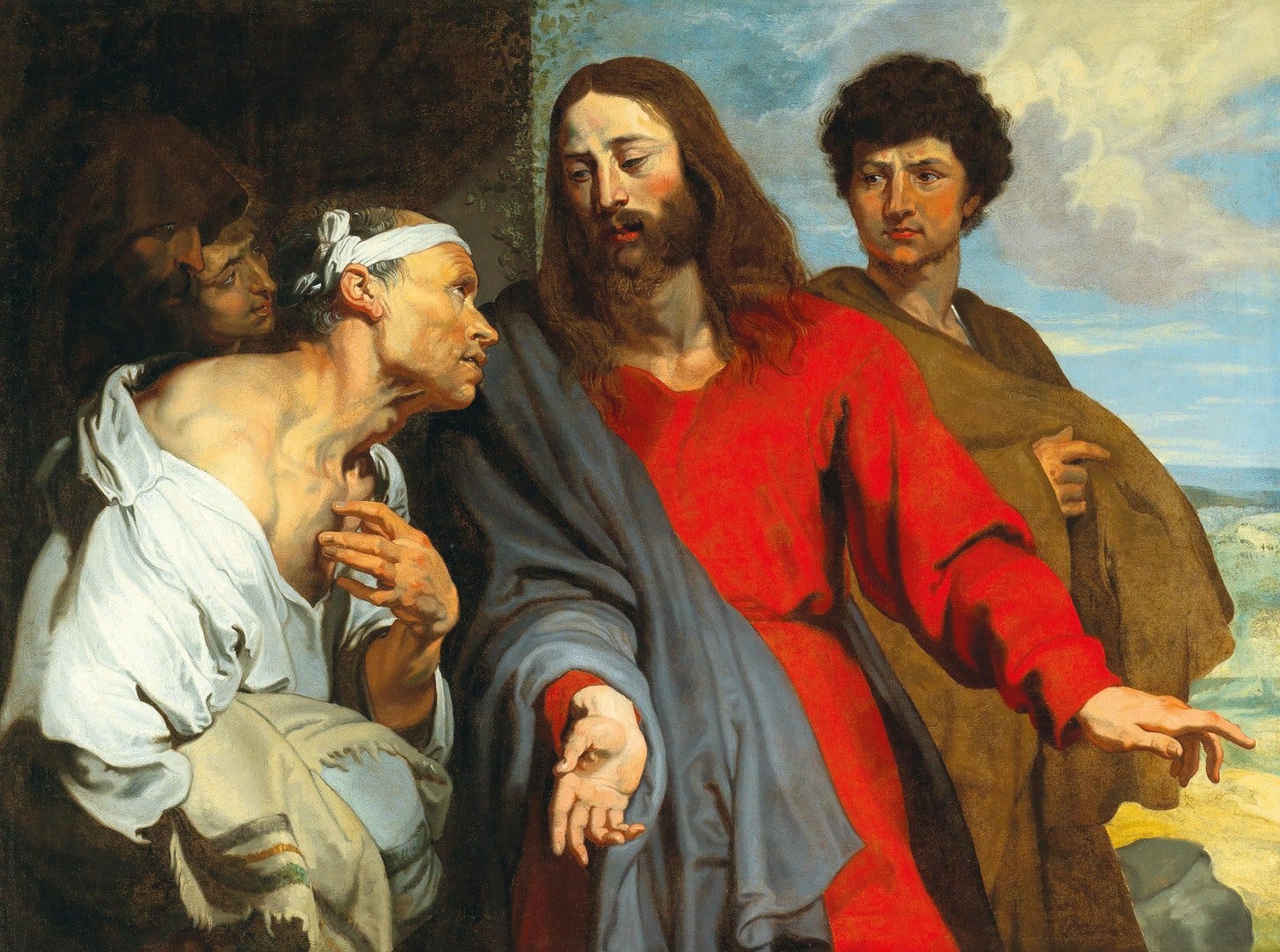
And when Jesus saw their faith, he said to the paralytic, "Take heart, my son; your sins are forgiven."
Matthew 9:2
Historical Context
Matthew writes his Gospel for a Jewish audience, likely in the decades following the resurrection, presenting Jesus as the promised Messiah and rightful King of Israel. By chapter 9 he has already shown Jesus healing lepers, a centurion's servant, Peter's mother-in-law, and a demoniac. The pattern is deliberate: Matthew is building a case that this Galilean carpenter wields authority no rabbi has ever claimed.
The scene here takes place in Capernaum, which Matthew calls Jesus' "own city" (9:1). A paralytic is carried to him, likely by friends or family. Mark's parallel account tells us they dug through the roof; Matthew focuses instead on the confrontation that follows.
Two things a first-century Jewish reader would have known instantly. First, sin and physical suffering were widely assumed to be connected. Not always one-to-one, but the categories bled into each other. Second, and more importantly, only God forgives sins. This was settled ground. The sacrificial system at the temple was the appointed means by which God dispensed forgiveness, mediated through priests. No rabbi, no prophet, no teacher stood up and declared a person's sins forgiven on his own authority. To do so was either to claim to speak for God, which required a prophetic warrant, or to claim to be God, which was blasphemy punishable by death under Leviticus 24.
The scribes present are the theological professionals, trained in the Law and its interpretation. They understand exactly what Jesus has just done. Their charge of blasphemy is not paranoid overreach; it is the correct diagnosis if Jesus is anyone less than who he claims to be. Matthew wants us to feel the weight of that if.
Reflection
The friends brought a paralyzed man to Jesus for one obvious reason. Jesus addressed a different one first.
This should stop us. We tend to bring God our surface problems, the ones we can name, the ones that keep us up at night. The bill. The diagnosis. The strained marriage. The job. And Jesus, who is kind, does not despise those requests. But he sees underneath them to something we often would rather not discuss. Our sin. Our guilt before a holy God. The deep fracture that no healed body or fixed circumstance can mend.
Notice what Jesus calls the man: "my son." Then, "Take heart." Before a word about the paralysis, Jesus gives him tenderness and absolution. He treats the eternal problem as the urgent one, because it is.
And then he proves he has the right to do it. "Which is easier, to say, 'Your sins are forgiven,' or to say, 'Rise and walk'?" Saying either is easy. Doing either is impossible for a mere man. So Jesus does the visible impossible thing to authenticate the invisible one. The healed legs are the receipt for the forgiven soul.
This is the whole gospel in miniature. Jesus has authority to forgive sins because he is God in the flesh, and he will shortly go to a cross to purchase that forgiveness at the cost of his own blood. What he pronounces here he will pay for there.
So bring him your paralysis, whatever form it takes. But do not be surprised, and do not be offended, if he speaks first to the thing you did not ask him to touch. He loves you too much to heal only the symptom.
For Reflection
What is the surface request you keep bringing to God, and what deeper thing might he be trying to address underneath it?
Prayer
Lord Jesus, you see beneath what we ask for to what we truly need. We confess we often want relief more than we want you, and healing more than we want holiness. Forgive us. Speak your word of pardon over us today, and give us grace to receive it as the greatest gift. Heal what you will heal, and in all things teach us to trust the authority of the Son of Man, who bore our sins on the tree. In Jesus' name, Amen.
Paid subscribers get the study section below: the word behind the English, the setting, and where this thread runs through the rest of Scripture.