

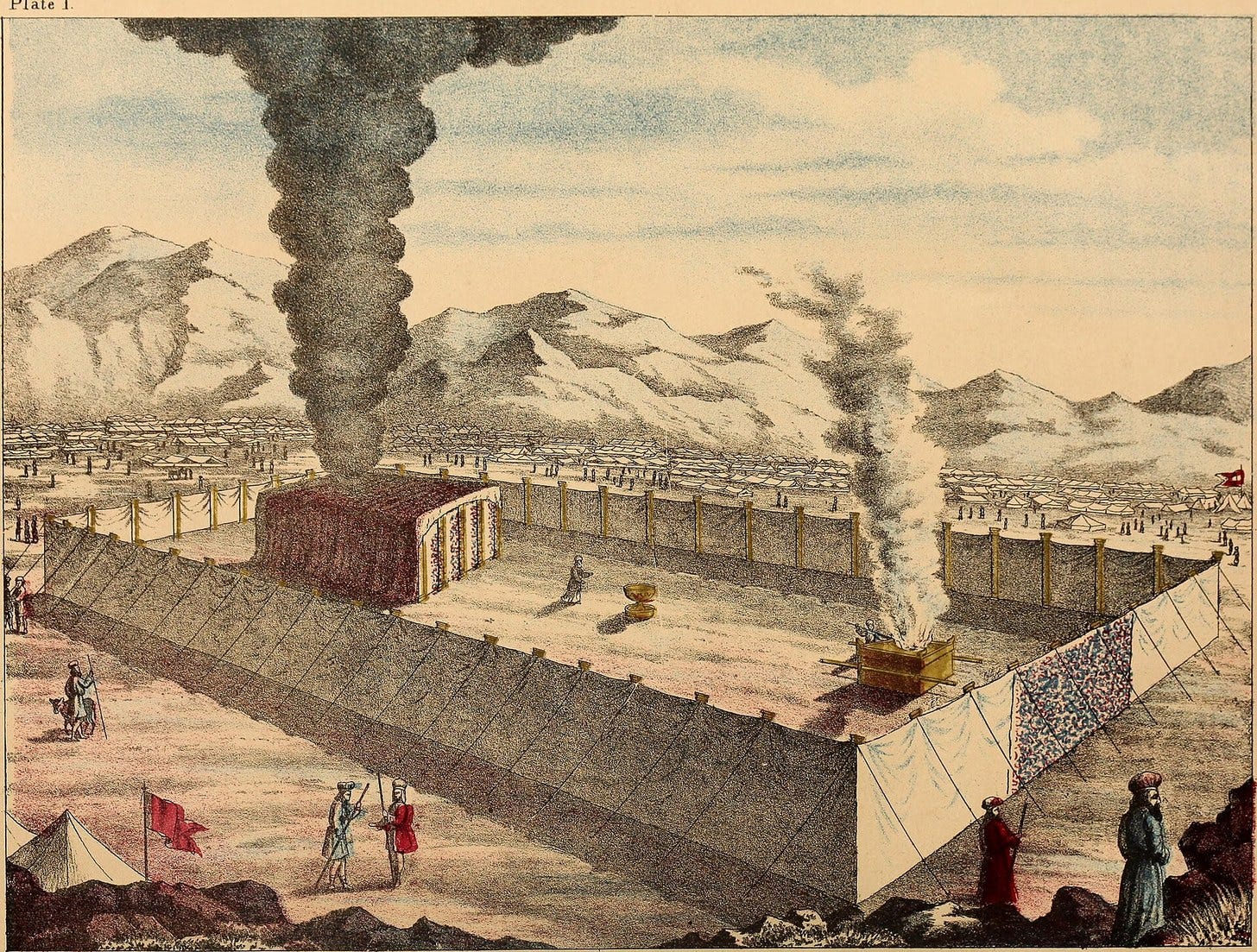
Today's Verse
Then the cloud covered the tent of meeting, and the glory of the LORD filled the tabernacle.
Exodus 40:34
Historical Context
Exodus closes where it has been pointing since chapter 25: God dwelling in the midst of his people. Moses wrote this account for Israel in the wilderness, a nation newly ransomed from Egypt and still learning what it meant to belong to the LORD. The book began with slaves crying out under Pharaoh. It ends with those same slaves watching the glory of God settle over a tent they built with their own hands.
The tabernacle was no ordinary structure. God had given Moses the pattern on Sinai (Exodus 25:9), and chapters 25-31 record the blueprint, chapters 35-40 the execution. Every curtain, hook, and board was made to specification. The materials came from a freewill offering so generous Moses had to tell the people to stop giving (Exodus 36:6-7). Bezalel and Oholiab, filled with the Spirit of God, oversaw the craftsmanship.
The original readers would have caught something modern readers often miss: the tabernacle was a portable Sinai. On the mountain, the cloud of glory had descended, fire had burned, and Moses had drawn near while the people kept their distance. Now that same cloud rests over a tent in the camp. God is not confined to a mountain in the distance. He travels with his people.
The pillar of cloud and fire, already their guide out of Egypt (Exodus 13:21-22), now has a home. When it lifted, Israel marched. When it rested, they camped. Their entire life was ordered by the visible presence of God. Exodus does not end with Israel arriving in the Promised Land. It ends with God arriving among his people. That is the deeper deliverance the whole book has been driving toward.
Reflection
Notice what happens the moment the work is finished. God moves in. Not partially. Not symbolically. The glory of the LORD fills the tabernacle so completely that even Moses, who had stood on Sinai and spoken with God face to face, cannot enter. The presence is that heavy, that real.
This is the pattern of grace. God does not dwell with his people because they are impressive. He dwells with them because he is faithful. Only a few chapters earlier, Israel had melted down their gold into a calf. And yet here, at the end of the book, the LORD himself takes up residence in their camp. The glory that filled the tabernacle was not a reward for their righteousness. It was a gift grounded in his covenant.
The New Testament takes this scene and sets it ablaze. John writes that the Word became flesh and tabernacled among us, and we have seen his glory (John 1:14). The tent in the wilderness was pointing to a Person. And Paul tells us that if you belong to Christ, your body is now the temple of the Holy Spirit (1 Corinthians 6:19). The cloud has not merely come near you. He has come into you.
So the question presses: are you ordering your life by the presence of God, or by your own itinerary? Israel did not move when the cloud did not move. They did not stay when the cloud lifted. Their whole rhythm, down to pulling up tent pegs, was shaped by the LORD who dwelt with them. We who have the Spirit have no excuse to live as practical nomads, charting our own course. The glory has filled the tent. Follow where he leads.
For Reflection
Where in your life right now are you tempted to move ahead of the cloud, or to stay put when God is clearly calling you forward?
Prayer
Father, you are the God who dwells with your people. Thank you for not leaving us in Egypt, and for not leaving us at Sinai, but for coming to tabernacle among us in Christ and now within us by your Spirit. Teach us to recognize your presence, to honor your glory, and to move only when you move. Keep us from running ahead of you and from lagging behind. Fill us as you filled the tent, until there is no room left in us for anything but you. In Jesus' name, Amen.
Paid subscribers get the study section below: the word behind the English, the setting, and where this thread runs through the rest of Scripture.