

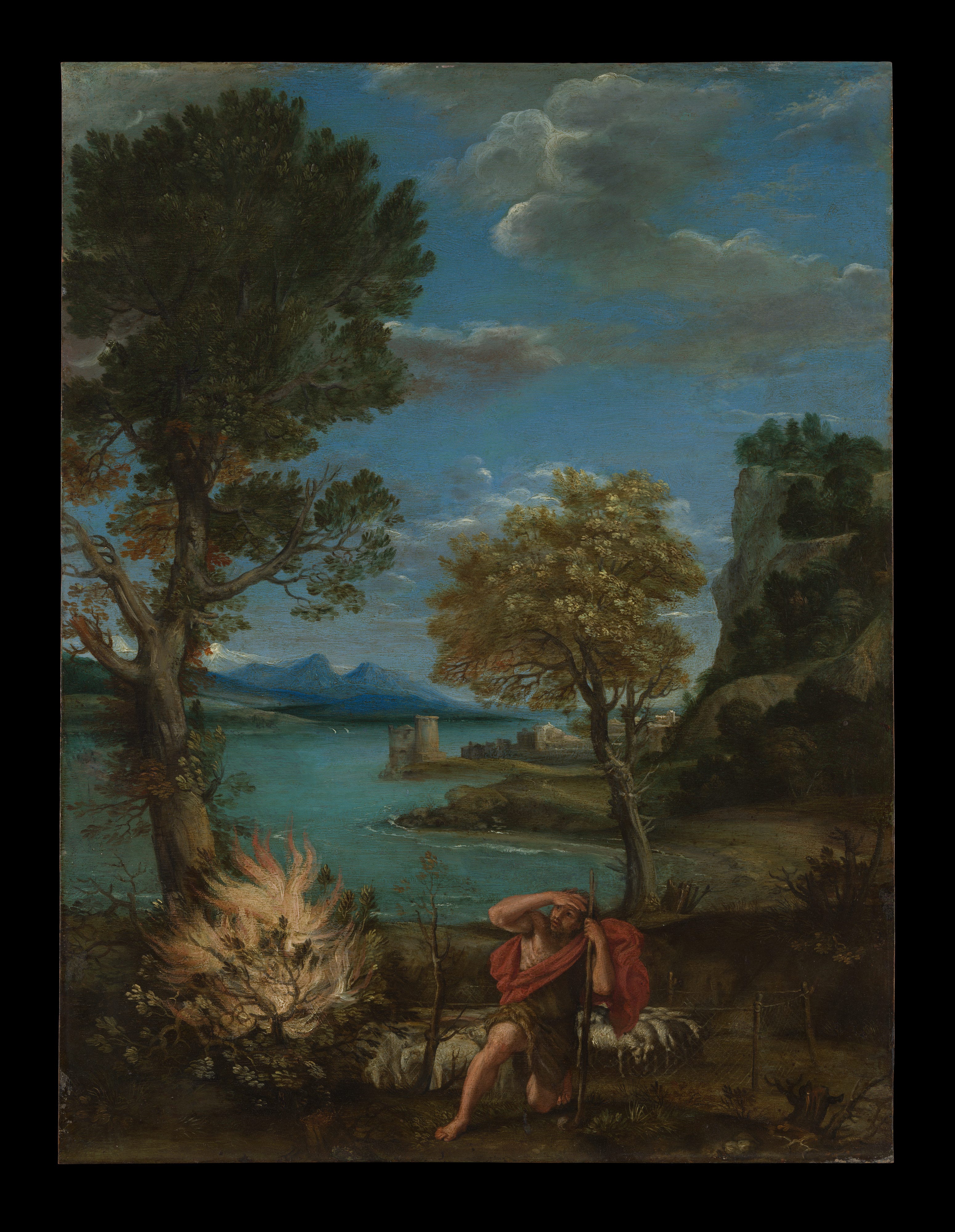
Today's Verse
Then he said, "Do not come near; take your sandals off your feet, for the place on which you are standing is holy ground."
Exodus 3:5
Historical Context
Moses is forty years into obscurity. Once a prince of Egypt, he had killed a man, fled Pharaoh's wrath, and settled in Midian, marrying into the family of Jethro, a local priest. The heir apparent of the world's greatest empire is now a hired shepherd in the desert, tending someone else's animals. His people, meanwhile, are still groaning under Egyptian slavery — the cries that opened chapter 2 have gone up to God, and God has "remembered" his covenant with Abraham, Isaac, and Jacob (Ex. 2:24).
Horeb — another name for Sinai — is called "the mountain of God" here almost by anticipation. It will become the mountain of the covenant, the mountain of the Law, the mountain where Israel meets the LORD as a nation. But on this day it is just a rock in the wilderness, and Moses is just a man looking for pasture.
The "angel of the LORD" in verse 2 is no ordinary messenger. Verse 4 identifies the speaker as the LORD himself — YHWH — and God speaks in the first person throughout. Ancient readers understood: this is a genuine appearance of God, a theophany, communicated through fire that burns without consuming. Fire in the Old Testament is God's signature: consuming, purifying, dangerous, holy.
The command to remove sandals reflects ancient Near Eastern reverence — you did not track the dirt of the common road onto sacred space. But here the meaning runs deeper. The ground is not holy because of the mountain. The ground is holy because God is there. Moses is being taught, before he is sent, what kind of God is sending him.
Reflection
God meets Moses in the middle of a workday. Not in a temple, not in a vision quest, not after weeks of fasting — while he is watching sheep. The God of Abraham interrupts the ordinary, and the ordinary becomes the doorway to the extraordinary.
But notice what God does not do. He does not embrace Moses. He does not begin with warm assurances. His first word is a boundary: "Do not come near." Before Moses can be commissioned, he must learn that the God who calls him is holy — set apart, other, dangerous in his purity. The bush that burns without being consumed is a parable of God himself: self-sustaining, self-existing, needing nothing, giving everything. This is the God who a few verses later will name himself "I AM."
We have lost much of this. Modern religion tends to reach for the friendly God, the God who is a supportive companion, the God who exists to affirm us. That God does not exist. The God who does exist is the God of the burning bush — the God before whom Moses hid his face, afraid to look. And yet — this is the wonder — this holy God knows Moses by name, and calls him twice, tenderly: "Moses, Moses."
Holiness and nearness are not opposites in the God of the Bible. They meet supremely at the cross, where the fire that would consume us fell on Christ instead, so that we could be brought near without being destroyed. The ground beneath your feet today, wherever you stand, is holy ground if the Lord is there. Take off your sandals. Come with reverence. He is calling your name.
For Reflection
Where in your ordinary week — your workplace, your kitchen, your commute — might God be waiting to meet you, if only you would turn aside to see?
Prayer
Holy Father, you are the God who dwells in unapproachable light, and yet you call us by name. Forgive us for the smallness of our thoughts about you, for approaching you casually when we should tremble, and for forgetting you when we should worship. Give us eyes to see the fire in the bush — to notice you at work in the ordinary places of our lives. Draw us near through the blood of your Son, that we may stand on holy ground unafraid. In Jesus' name, Amen.
Recent Devotionals
He Leaps Over the Mountains to Find You — July 8, 2026
The Voice That Calls You Out of Winter — July 7, 2026
Arise, My Love, and Come Away — July 5, 2026
Image: Domenichino (Domenico Zampieri), Landscape with Moses and the Burning Bush, c. 1610–16, Metropolitan Museum of Art, New York — Gift of Mr. and Mrs. Charles Wrightsman, 1976 via The Metropolitan Museum of Art.
Scripture quotations are from the ESV® Bible (The Holy Bible, English Standard Version®), copyright © 2001 by Crossway, a publishing ministry of Good News Publishers. Used by permission. All rights reserved.
Awesomeness, inspiring understanding and if each of us had our relationship with God to know that we’re standing on Holy Ground no matter what geographical location how much better would we feel towards one another…