

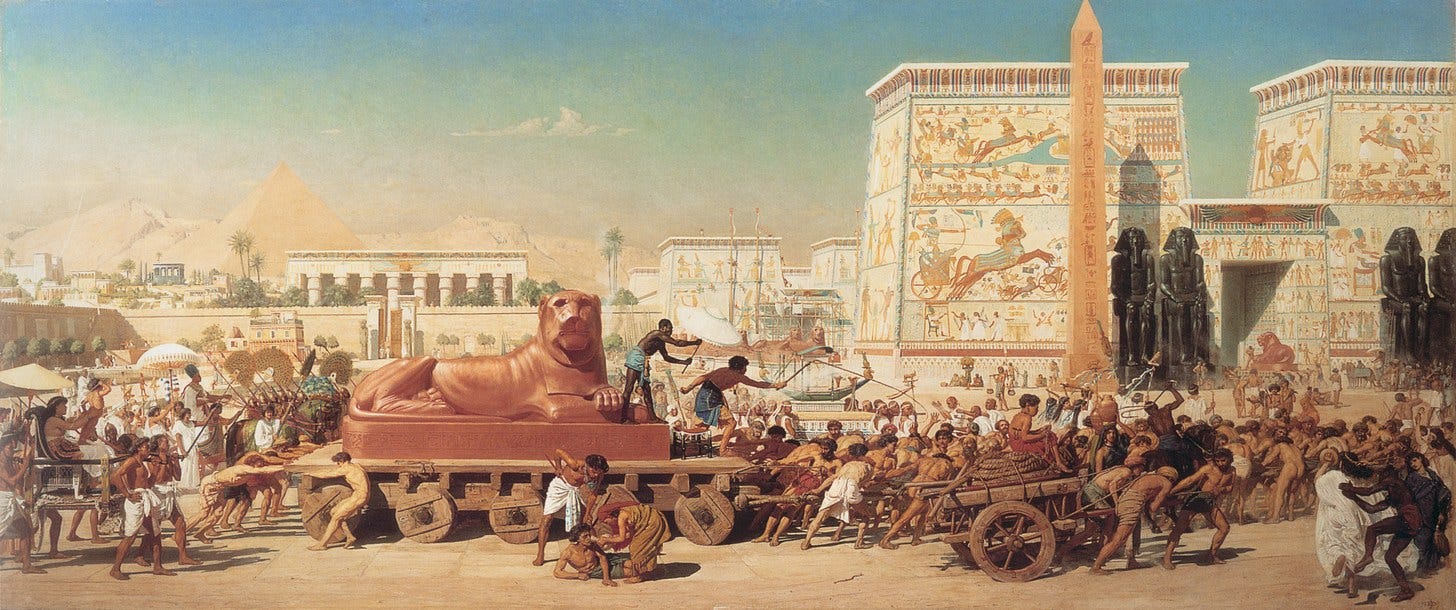
Today's Verse
During those many days the king of Egypt died, and the people of Israel groaned because of their slavery and cried out for help. Their cry for rescue from slavery came up to God. And God heard their groaning, and God remembered his covenant with Abraham, with Isaac, and with Jacob.
Exodus 2:23-24
Historical Context
Exodus opens roughly four hundred years after Joseph. The Israelites who had settled in Goshen as honored guests are now state slaves, conscripted to build the store cities of Pithom and Raamses under a Pharaoh 'who did not know Joseph.' Moses, born under a genocidal edict, was rescued from the Nile, raised in Pharaoh's household, killed an Egyptian, and fled to Midian. When our passage opens, he has been tending sheep in the desert for around forty years. The generation that first entered slavery has died. So has the generation that remembered him. So, now, has the Pharaoh he fled.
Modern readers hear 'the king of Egypt died' and think of a political shift. The original audience heard something heavier. Pharaoh was not merely a monarch; he was worshipped as a god, the son of Ra, the living link between heaven and earth. His death was supposed to be cosmically significant. Moses records it in half a sentence. The real news is in the next line: Israel groaned, and God heard.
The four verbs stacked in verse 24 and following (heard, remembered, saw, knew) are covenant language. To 'remember' in Hebrew narrative does not mean God had forgotten; it means He is about to act on what He promised. The covenant in view was cut with Abraham in Genesis 15, where God foretold this very slavery and this very deliverance. Israel does not yet know rescue is coming. Moses does not yet know he will lead it. But the God who binds Himself with oaths is already moving. The rest of Exodus is the unfolding of these two verses.
Reflection
There are seasons in the Christian life that feel like Exodus 2. The oppression has gone on for years. Prayers seem to disappear into the ceiling. The people who once helped are gone. And then Scripture tells us something the Israelites in the brickyards did not know as they groaned: their cry was going up to God, and God was already remembering His covenant.
Notice what this passage does not say. It does not say Israel prayed with great faith, or repented thoroughly, or cried out with theological precision. They groaned. That is the word for wordless suffering, the noise a body makes when it can no longer form sentences. And God heard it. He did not require them to phrase their pain properly before He acted.
But hear this carefully, because our age will misread it. God did not act because Israel groaned. He acted because He had promised. The ground of rescue is not the intensity of our cry but the faithfulness of His covenant. That is the whole gospel in miniature. Christ did not die because we were loud enough in our need. He died because the Father had promised, from Genesis 3 onward, to crush the serpent and save a people for Himself. Your salvation rests on an oath older than your suffering.
So if you are in the brickyard right now, groan honestly. God is not offended by inarticulate grief. But do not build your hope on the quality of your groaning. Build it on the covenant sealed in the blood of Jesus, the covenant God cannot forget because He swore it by Himself. He heard Israel. He hears you. And what He remembers, He acts on.
For Reflection
Where in your life right now are you tempted to measure God's nearness by the intensity of your feelings rather than by the faithfulness of His covenant?
Prayer
Father, we thank You that You are a God who hears wordless groaning and remembers ancient promises. We confess we often mistake Your silence for absence and Your patience for neglect. Teach us to rest not on the strength of our praying but on the strength of Your covenant, sealed in the blood of Your Son. Where we are enslaved, deliver us. Where we are waiting, sustain us. Where we are groaning, hear us. In Jesus' name, Amen.
Paid subscribers get the study section below: the word behind the English, the setting, and where this thread runs through the rest of Scripture.