

Today's Verse
Note then the kindness and the severity of God: severity toward those who have fallen, but God's kindness to you, provided you continue in his kindness. Otherwise you too will be cut off.
Romans 11:22
Historical Context
Paul wrote Romans around A.D. 57, likely from Corinth, to a mixed congregation of Jewish and Gentile believers in the imperial capital. The church there had a complicated history. In A.D. 49 the emperor Claudius expelled Jews from Rome (Acts 18:2), which meant that for several years the Roman house churches were led almost entirely by Gentiles. When Claudius died in A.D. 54 and the Jewish believers began returning, they came back to congregations that had grown used to functioning without them. Tensions followed. Who really belonged? Whose customs shaped worship? Had God moved on from Israel?
Chapters 9-11 are Paul's sustained answer. He has already argued that Israel's stumbling was not final and not total, that a remnant remains, and that God's word has not failed. Now in 11:13-29 he turns directly to the Gentile Christians in the room and speaks plainly. He uses the image of an olive tree, a familiar symbol of Israel in the Old Testament (Jeremiah 11:16, Hosea 14:6). The cultivated tree is God's covenant people rooted in the patriarchs. Some natural branches, unbelieving Israelites, have been broken off. Wild olive shoots, believing Gentiles, have been grafted in against the ordinary practice of horticulture, which grafts cultivated branches onto wild stock, not the other way around.
Paul's readers would have caught the strangeness immediately. This is not how olive farming works. That is exactly the point. Gentile inclusion is an act of sheer grace, and it gives no ground whatever for looking down on the branches that were removed.
Reflection
Paul is speaking to Christians who might be tempted to feel superior, and he will not have it. The Gentile believer did not earn a place at the root of Israel. He was grafted in. The sap that feeds him is not his own. The covenant promises he now enjoys were spoken to Abraham long before he existed.
That should end all boasting. And yet spiritual pride is a stubborn weed. It grows in the Christian who congratulates himself on his theology while looking down on those who have not yet believed. It grows in the church that forgets it stands only by grace and starts imagining it stands by pedigree, by tradition, by cleverness, by numbers. Paul's word is blunt: if God did not spare the natural branches, neither will he spare you.
Hold the two words together, because Paul does. Kindness and severity. God is kind, extravagantly kind, kinder than we deserve or dare to ask. And God is severe. He does cut off. He does judge unbelief. The gospel is not a promise that everyone ends up safe regardless. It is a promise that everyone who continues in faith is safe, held by a root they did not plant.
So the Christian life is lived in the posture Paul commands here: not proud, but fearing. Not smug, but grateful. Not looking down on the unbelieving neighbor, the wandering relative, the Jewish friend who has not yet seen Jesus as Messiah, but praying for them, longing for their grafting in, remembering that the God who saved you can save them too. The gifts and the calling of God are irrevocable. He is not finished.
For Reflection
Where in your own heart does spiritual pride quietly grow, and what would it look like this week to stand in grateful fear instead?
Prayer
Father, we thank you that in your kindness you have grafted us into the covenant people of your Son. We did not earn this place. We do not sustain it. Guard us from arrogance toward those still outside, and from forgetting that we stand only by faith. Give us hearts that long for the salvation of your ancient people and of every neighbor who has not yet believed. Keep us in your kindness until the day we see you face to face. In Jesus' name, Amen.
Recent Devotionals
Watchmen Waiting for the Morning — August 17, 2026
God Sent Me Before You to Preserve Life — August 16, 2026
The Long Memory of an Unconfessed Sin — August 15, 2026
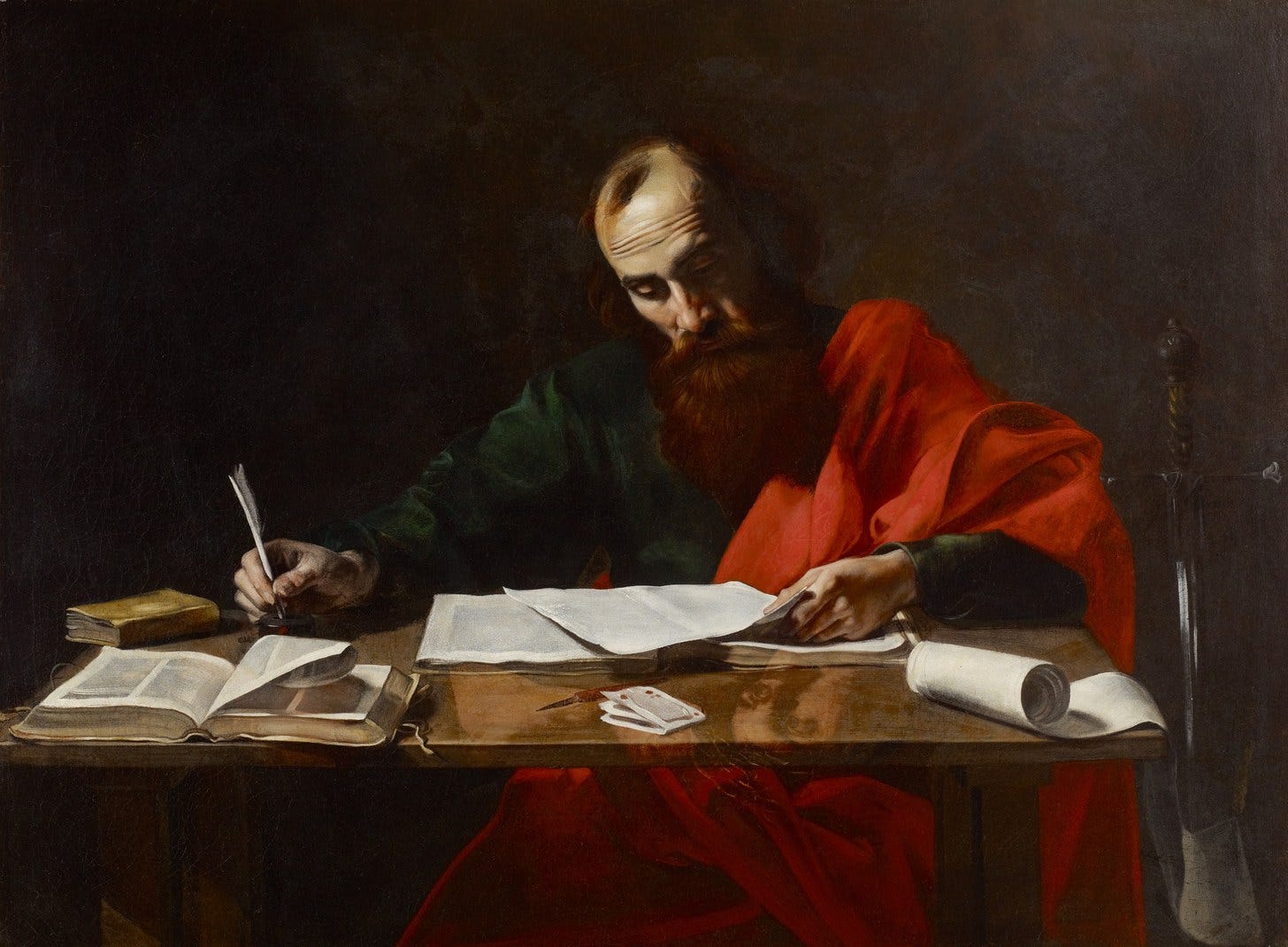
Image: Valentin de Boulogne, File:Valentin de Boulogne - Saint Paul Writing His Epistles - BF.1991.4 - Museum of Fine Arts.jpg, c. 1618 — Public domain via Wikimedia Commons.
Scripture quotations are from the ESV® Bible (The Holy Bible, English Standard Version®), copyright © 2001 by Crossway, a publishing ministry of Good News Publishers. Used by permission. All rights reserved.
It all started with pride.
Isaiah 14:13-14 KJV — For thou hast said in thine heart, I will ascend into heaven, I will exalt my throne above the stars of God: I will sit also upon the mount of the congregation, in the sides of the north: I will ascend above the heights of the clouds; I will be like the most High.