

Today's Verse
fear not, for I am with you;
be not dismayed, for I am your God;
I will strengthen you, I will help you,
I will uphold you with my righteous right hand.
Isaiah 41:10 (ESV)
Historical Context
Isaiah 41 belongs to a section of the book (chapters 40–48) that speaks to Israel about the coming Babylonian exile and God's promise of restoration. The prophet writes to a people who will lose everything they thought made them God's people — the temple, the land, the Davidic king on the throne. In exile, surrounded by the towering ziggurats and gods of Babylon, Israel would be tempted to conclude that their God had lost, or that He had discarded them for their sins.
Into that despair, chapter 41 opens with a courtroom scene. God summons the nations to trial and challenges the pagan gods to prove they can do anything — predict the future, save their people, act at all. They cannot. Then, in verse 8, the tone shifts from thunder to tenderness. God turns to His covenant people and calls them by their family names: Israel, Jacob, offspring of Abraham. He reminds them that their identity does not rest on their performance or their circumstances but on His choosing.
The phrase "my friend," applied to Abraham, is striking. It becomes a title (2 Chronicles 20:7, James 2:23). The God who spoke the stars into being condescends to call a man His friend — and to bind Himself by covenant to that friend's descendants.
"The ends of the earth" and "farthest corners" would have resonated painfully with exiles scattered far from home. God is saying: even there, especially there, you are still Mine. I did not lose you. I called you. And where I have called, I will keep.
Reflection
There is a particular kind of fear that comes when you feel far from where you should be. Far from the person you meant to become. Far from the closeness with God you once had. Far from home, spiritually or literally. That is the fear Isaiah 41 addresses.
Notice what God does not say. He does not say, "Pull yourself together." He does not say, "Try harder and I will meet you halfway." He grounds the command "fear not" in something outside you: "for I am with you… for I am your God." The reason not to be afraid is not that your situation is manageable. It is that He is present, and He is yours.
Then come four verbs, stacked like beams: I have chosen, I will strengthen, I will help, I will uphold. Every one of them is His action, not yours. This is the shape of grace. We do not climb up to God; He reaches down. And the hand that upholds you is called "righteous" — meaning it will not fail, will not slip, will not let you go because you disappointed Him this week.
For the Christian, this promise finds its deepest ground at the cross. The righteous right hand that upholds you is the hand pierced for you. Christ bore the judgment your sin deserved so that God's presence with you is no longer a threat but a comfort. The Father does not tolerate you on a technicality; He holds you as His own child.
Whoever you are today — anxious, ashamed, exhausted, far off — hear Him: I have chosen you and not cast you off. Fear not.
For Reflection
Where in your life right now are you being tempted to believe that God has cast you off, and what would change if you took Him at His word instead?
Prayer
Father, I am often afraid, and often ashamed of how afraid I am. Thank You that Your promise does not rest on my strength but on Yours. Thank You that in Christ You have chosen me and will not cast me off. Steady my heart today. Strengthen me where I am weak, help me where I am helpless, and uphold me with Your righteous right hand — the hand that was pierced for my sake. In Jesus' name, Amen.
Recent Devotionals
Contentment Is Something You Learn — July 30, 2026
The Hidden Life of the Kingdom — July 29, 2026
Something Greater Than Jonah Is Here — July 25, 2026
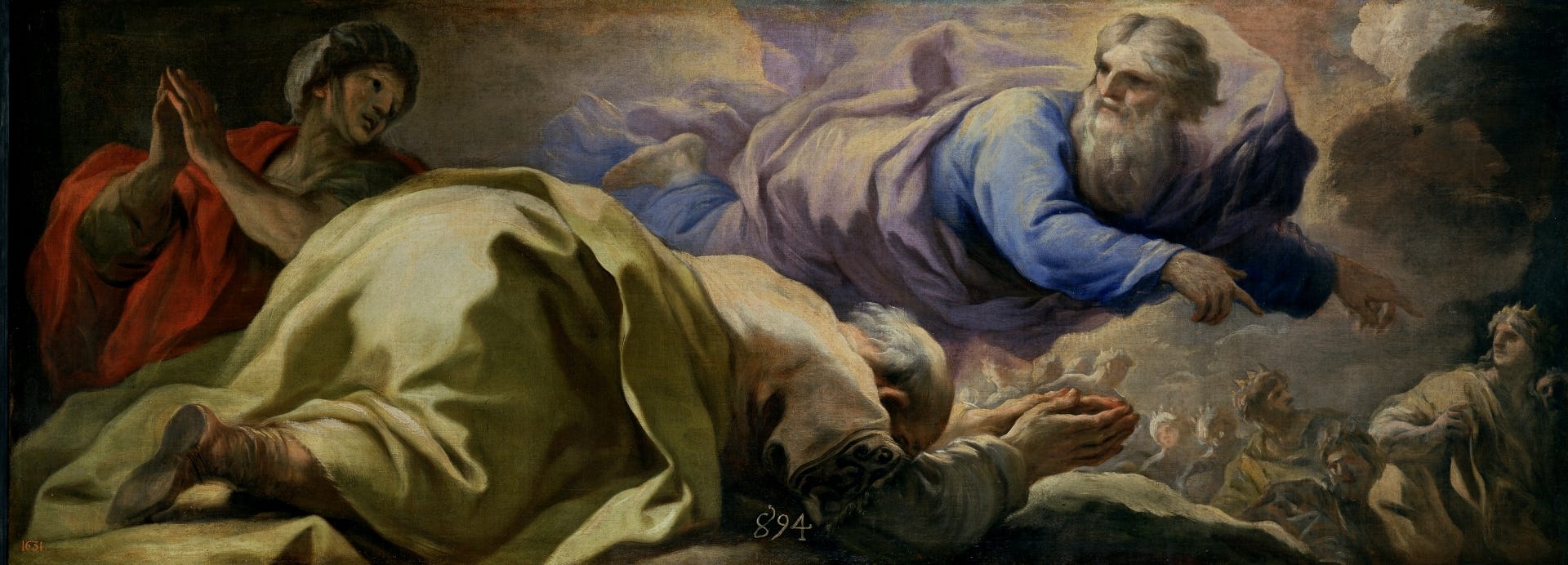
Image: Luca Giordano, File:Abraham escucha las promesas del Señor.jpg, c. 1694 — Public domain via Wikimedia Commons.
Scripture quotations are from the ESV® Bible (The Holy Bible, English Standard Version®), copyright © 2001 by Crossway, a publishing ministry of Good News Publishers. Used by permission. All rights reserved.
Amen
Amen