

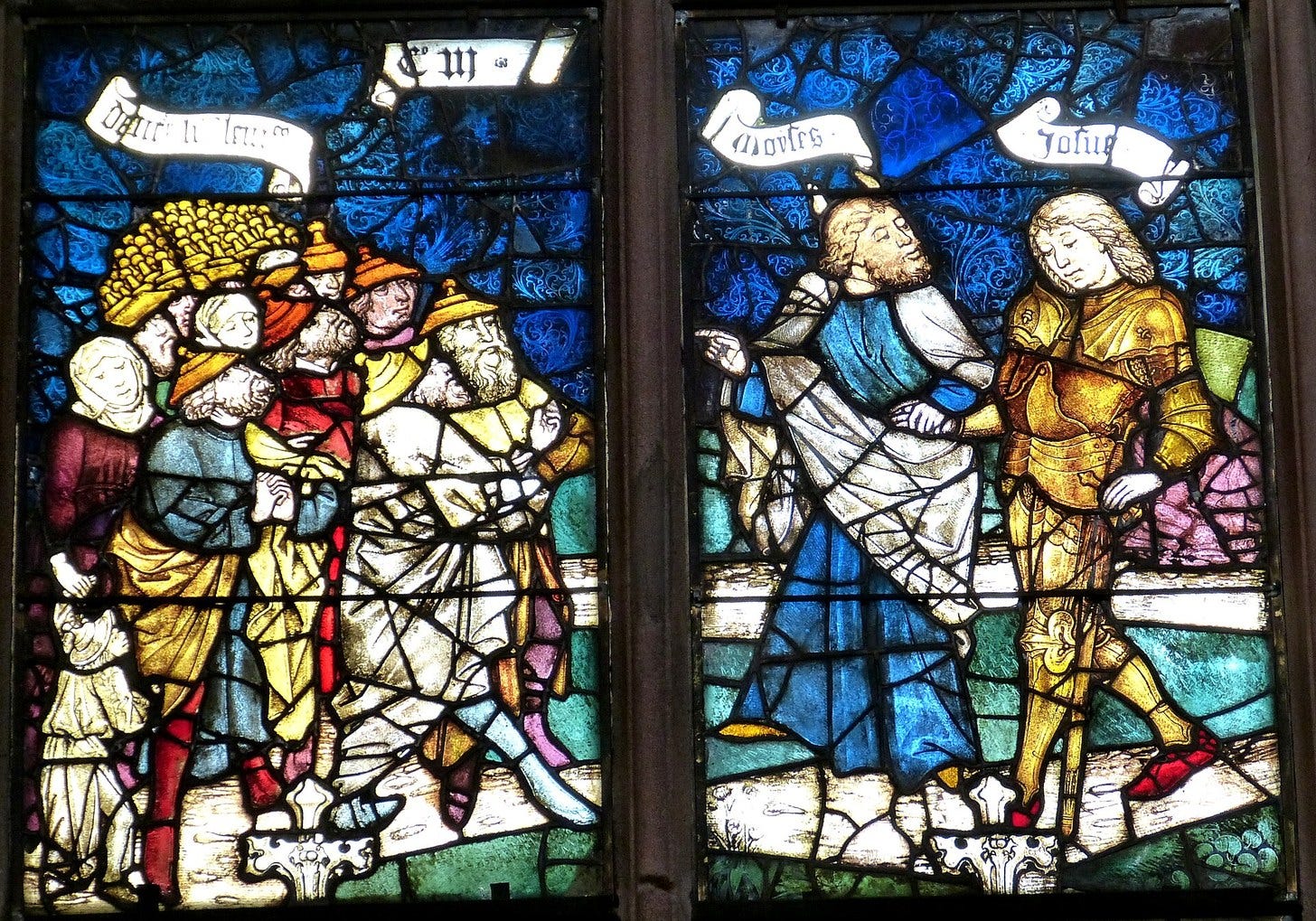
Today's Verse
Have I not commanded you? Be strong and courageous. Do not be frightened, and do not be dismayed, for the LORD your God is with you wherever you go.
Joshua 1:9
Historical Context
Joshua opens on the plains of Moab, east of the Jordan, around 1400 BC by the traditional dating. Moses is dead. For forty years he has been the voice of God to Israel, the man who faced down Pharaoh, who stood on Sinai, whose face shone from speaking with the Lord. Now he is buried in an unmarked grave, and the people are leaderless on the wrong side of the river.
Joshua is not a young man. He is likely in his eighties, one of only two adults from the Exodus generation still alive, the other being Caleb. He has been Moses' assistant since the beginning, the one who went partway up Sinai, who guarded the tent of meeting, who led Israel to victory against Amalek. He knows the land because he was one of the twelve spies, and one of only two who came back believing God.
The book is written to Israel as the account of how the LORD gave them the land He had sworn to Abraham, Isaac, and Jacob some six centuries earlier. The territory described in verse 4 reaches from the Negev wilderness in the south to Lebanon in the north, from the Mediterranean (the Great Sea) to the Euphrates. This is the full promise made to Abraham in Genesis 15.
The Jordan River at flood stage, which is when they will cross (Joshua 3:15), is a serious barrier. The fortified city of Jericho sits on the other side. Militarily, Israel is a wandering tribal people facing walled Canaanite cities. The command to be strong and courageous is not a motivational slogan. It is a command issued to a frightened man standing in front of a real river.
Reflection
Three times in nine verses God tells Joshua to be strong and courageous. He does not say it because Joshua feels brave. He says it because Joshua does not. God's commands often meet us precisely where our hearts fail.
Notice what grounds the courage. It is not Joshua's resume, though he has one. It is not the size of the army or the quality of the plan. The ground of courage is a Person: "the LORD your God is with you wherever you go." Everything else in the passage flows from that promise. The land will be taken because God gives it. No man will stand before Joshua because God stands with him. Success will come because God goes ahead.
And yet courage is not passive. God tells Joshua to arise, to cross, to be careful to obey the law, to meditate on the Book day and night, to command the officers, to prepare provisions. The presence of God does not replace the obedience of Joshua. It fuels it. The man who truly believes God is with him is the man who gets up and crosses the river.
Most of us are not facing Jericho. We are facing a difficult conversation, a diagnosis, a wayward child, a temptation that keeps winning, a calling we have been avoiding. The temptation is to wait until we feel ready. We will not feel ready. God does not ask us to feel ready. He asks us to go, and He promises to go with us.
The same Lord who said to Joshua, "I will not leave you or forsake you," says to His Church through the risen Christ, "I am with you always, to the end of the age." The promise has not weakened. It has deepened. Arise, and cross.
For Reflection
What is the Jordan God is calling you to cross right now, and what are you waiting for before you step in?
Prayer
Almighty God, You buried Moses and raised up Joshua, and You have never once abandoned Your people. Forgive me for the fear that keeps me on the wrong side of the river. Make me strong and courageous, not in myself but in Your presence with me. Teach me to meditate on Your Word day and night, and give me the obedience that rises up and crosses over. I trust Your promise never to leave or forsake me. In Jesus' name, Amen.
Paid subscribers get the study section below: the word behind the English, the setting, and where this thread runs through the rest of Scripture.