

Today's Verse
“If you then, who are evil, know how to give good gifts to your children, how much more will your Father who is in heaven give good things to those who ask him!”
Matthew 7:11
Historical Context
These verses sit near the end of the Sermon on the Mount, Matthew's carefully arranged account of Jesus' teaching to His disciples on a hillside in Galilee, likely early in His public ministry. Matthew, writing for a largely Jewish-Christian audience sometime in the first century, presents Jesus as the true Teacher of Israel, delivering a new law from a new mountain — echoes of Moses at Sinai his readers would not miss.
The Sermon is not a random collection of sayings. It moves from the Beatitudes through Kingdom ethics, through instruction on prayer (including the Lord's Prayer in chapter 6), and now toward its conclusion. By the time we reach 7:7, Jesus has already told His disciples to pray in secret, to trust the Father for daily bread, and not to be anxious about food or clothing because “your heavenly Father knows what you need.” The command to ask, seek, and knock is the natural climax of all that.
The imagery would land hard on Jewish ears. A father giving his son a stone instead of bread, or a serpent instead of a fish, was unthinkable — a grotesque betrayal of the covenantal bond between father and child. Bread and fish were staples of the Galilean diet; every listener knew what a hungry child asking for supper looked like.
And Jesus does something startling in verse 11. He calls His hearers “evil.” Not merely flawed, not merely well-meaning. Evil. Yet even evil fathers, He says, know how to give good gifts. His argument is from lesser to greater: if that is true of sinful men, how much more of the Father in heaven who is perfectly holy and perfectly good.
Reflection
Most of us do not struggle to believe God can answer prayer. We struggle to believe He wants to. Somewhere beneath the surface we suspect the Father is reluctant, distracted, or displeased — that we must pry blessings out of tight hands.
Jesus dismantles that suspicion in a sentence. If you, being evil, still know how to feed your child, how much more your Father in heaven. Notice He does not flatter us. He calls us evil and means it. The doctrine of sin is not softened here; it is assumed. But that assumption is the very hinge of the argument. The goodness of the Father is not measured against our goodness — it towers over it.
This is not a promise that God gives us whatever we want. James later warns that we ask and do not receive because we ask wrongly, to spend on our passions. Jesus says the Father gives “good things,” and Luke's parallel says “the Holy Spirit.” The Father knows the difference between bread and stones better than we do. Sometimes what we call bread is a stone, and what feels like a stone in His hand turns out to be bread.
So ask. Keep asking. Keep seeking. Keep knocking. The verbs in Greek are continuous — not one desperate cry and silence, but a settled posture of dependence. Prayer is not the art of twisting a divine arm; it is the child's confidence that the Father's door is not locked against him.
And remember at what cost that door was opened. The Father did not spare His own Son but gave Him up for us all. If He gave us Christ, He will not withhold anything we truly need.
For Reflection
Where in your life have you stopped asking God because you have quietly assumed He is unwilling to give?
Prayer
Father in heaven, forgive me for the small view I have often had of You. I have treated Your door as though it were bolted, when You have thrown it open in Christ. Teach me to ask boldly, to seek patiently, to knock without shame. Give me the Holy Spirit, the best of all good gifts, and shape my desires until I long for what You most delight to give. I trust Your goodness even when Your answers surprise me. In Jesus' name, Amen.
Recent Devotionals
Called from the Farthest Corners — July 31, 2026
Contentment Is Something You Learn — July 30, 2026
The Hidden Life of the Kingdom — July 29, 2026
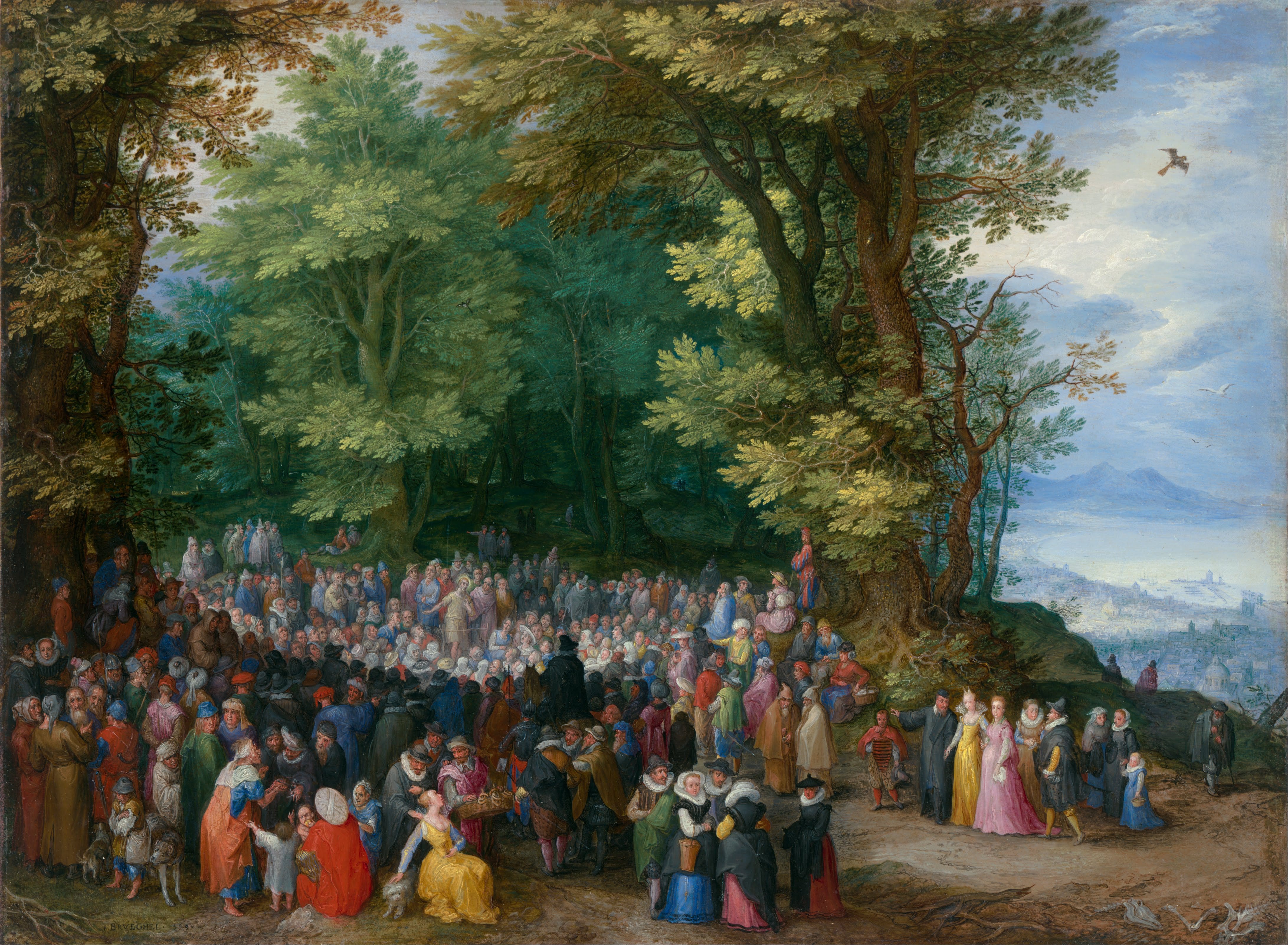
Image: Jan Brueghel the Elder, File:Jan Brueghel the Elder - The Sermon on the Mount - Google Art Project.jpg, c. 1598 — Public domain via Wikimedia Commons.
Scripture quotations are from the ESV® Bible (The Holy Bible, English Standard Version®), copyright © 2001 by Crossway, a publishing ministry of Good News Publishers. Used by permission. All rights reserved.
Thank You Father for hearing my prayers and for the opportunity to boldly come to You with the trials and tribulations of my life and every single thing that You care about. Thank You Lord Jesus Christ for interceding for me because sometimes I don’t know what to pray about❣️🙏AMEN 🙏💕❤️✝️❤️🩹💯😻
Jesus is Lord. Father, Son, Holy Spirit. God in 3 persons.