

Today's Verse
I cry to you, O LORD;
I say, "You are my refuge,
my portion in the land of the living."
Psalm 142:5
Historical Context
The superscription tells us this is a maskil — a teaching psalm — composed by David "when he was in the cave." Most likely this is the cave of Adullam (1 Samuel 22) or the cave at En-gedi (1 Samuel 24), where David hid from Saul. He had already been anointed king by Samuel. He had already killed Goliath. He had already been Saul's celebrated captain. And now he is a fugitive, sleeping in rock crevices in the Judean wilderness, hunted by the very king he had served.
Caves in that country are not romantic hiding places. They are damp, dark, cramped, often shared with wild animals. Saul had four thousand men. David had a growing band of the discontented and desperate (1 Samuel 22:2) — hardly an army. To the outside eye, God's promise through Samuel looked like a cruel joke.
A maskil was written to instruct the congregation. That matters. David is not simply venting into the dark; he is deliberately teaching Israel — and us — how a righteous man prays when he is cornered. The Hebrew word translated "complaint" in verse 2 (siach) does not mean grumbling; it means the pouring out of anxious meditation. This is not a rebellious fist shaken at heaven. It is a son emptying his heart before his Father.
The psalm assumes what Israel's whole worship assumed: that the LORD hears, that He is near, and that covenant loyalty flows both ways. David can be this honest because he knows to whom he is speaking.
Reflection
There is a particular loneliness David names in verse 4 that many believers know but few will admit: "no one cares for my soul." Not that no one likes you — that no one is watching the deepest, truest part of you and taking responsibility for it. Friends drift. Family misunderstands. Coworkers see the surface. And you sit with the strange ache of being surrounded and unknown.
David does two things in that ache, and both are worth learning.
First, he uses his voice. Twice in verse 1: "With my voice… with my voice." He does not merely think his prayer. He speaks it. There is something about vocalizing our trouble to God that gathers the scattered pieces of a fainting spirit and hands them over. If you have been praying in your head for months and drying up, try opening your mouth, even alone in your car, and telling God plainly what is wrong.
Second, he names God's identity before he names his need. "You are my refuge, my portion in the land of the living." Notice: refuge, not rescue. David asks for rescue in the next breath, but he grounds himself first in who God is regardless of what God does next. If the cave is where you die, God is still your portion. If deliverance comes, God is still your portion. Circumstances cannot promote or demote Him.
And here is the gospel edge of this psalm: there is One who prayed a deeper version of it. Christ, in a darker cave — a tomb — was brought out that He might give thanks to His Father's name. Because He was raised, your cave is not the end of your story either. The righteous will surround you. He deals bountifully still.
For Reflection
What would change in your prayer life this week if you spoke your complaint aloud to God instead of only turning it over silently in your mind?
Prayer
Father, You know my way when my spirit faints within me. You see the traps I cannot see and the loneliness I cannot name. Teach me to lift my voice to You before I lift it to anyone else. You are my refuge and my portion — not only when You rescue me, but in the waiting, in the cave, in the dark. Bring me out that I may give thanks to Your name. And until You do, hold me fast in Christ, in whom every promise is Yes. In Jesus' name, Amen.
Recent Devotionals
The Word That Will Judge You on the Last Day — July 11, 2026
Take the Sandals Off Your Feet — July 9, 2026
He Leaps Over the Mountains to Find You — July 8, 2026
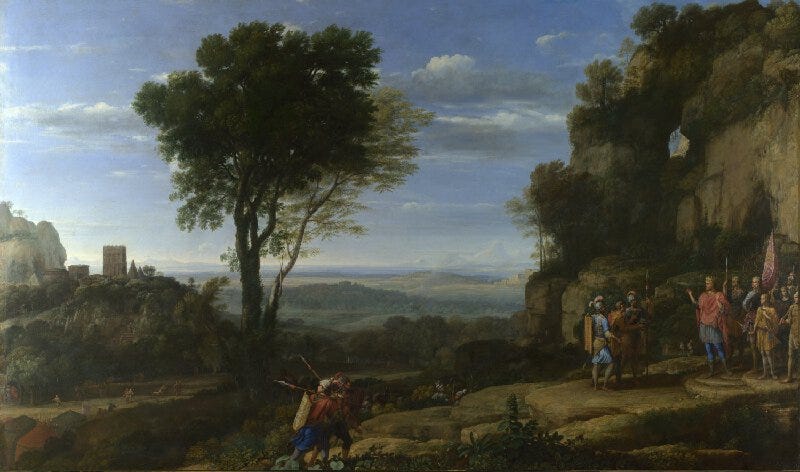
Image: Claude Lorrain, Landscape with David at the Cave of Adullam (Claude Lorrain) — the setting of Psalm 142, c. 1658, National Gallery, London — Public Domain via Wikimedia Commons.
Scripture quotations are from the ESV® Bible (The Holy Bible, English Standard Version®), copyright © 2001 by Crossway, a publishing ministry of Good News Publishers. Used by permission. All rights reserved.
"Circumstances cannot promote or demote Him."
💙
“Refuge, not rescue” stopped me. So often I come to God asking Him to change the cave before I remember He is already with me in it. Naming who He is before naming what I need changes the whole prayer.